

When Plain Women Write
Fantasy takes many different forms

This was an informative dialogue between the Original Sigma and a woman of talent who writes and illustrates one of the comics at Arktoons, Paper Doll Veronika.
Clockworkpaperdoll: I don’t think I understand the minds of men (tho I do better since I learned SSH), but as plain woman, I think I understand the minds of pretty women even less. Yet I endeavor to write fiction about both. Oh well! I am yet confident that by consciously eschewing Feminism, my portrayal of the sexes will be better than that in much current Western fiction.
VD: Why not write about plain women? Don’t they deserve attention too? The danger inherent about being a plain woman writing about pretty women is that it’s going to be Mary Sue wish-fulfillment.
Clockworkpaperdoll: Because I’m writing comics, so my readers have to look at them.

A salient point indeed. It’s not often that I am so swiftly and comprehensively defeated. In any visual art form, the people have to be pretty, because people like to look at pretty people. That’s just reality.
The rout notwithstanding, I was correct about the danger, because plain women writing about pretty women is exactly like Gammas writing about Alpha heroes. It’s usually subversive, if not inversive, and even at its best, it tends to amount to at least a degree of wish-fulfillment.
And one of the best examples of this I’ve ever seen is in the latest English translation of the latest French instructive novel published by Castalia House, SANS BEAUTY by Zénaïde Fleuriot. Note that I am not criticizing the novel, it is excellent, even better than La Petite Duchesse, its predecessor in the Daughters of France series, and at this point I am already convinced that the average Fleuriot novel is better than the average Louisa May Alcott or Laura Ingalls Wilder novel, and I’m not absolutely certain that she might not ultimately bear comparison with the Brontë sisters and Jane Austin as we delve deeper into her oeuvre.
That being said, I love Alcott’s Little Men and I’ve only read two of Fleuriot’s 89 novels so far, so it’s far too soon to have an opinion. It’s a matter that definitely demands attention and further investigation, but I digress…
It costs little to people of pleasing looks to declare that they were plain as children — the present redeems the past. But a good many like to persuade themselves there was once a moment when their irregular features were graceful, and will tell you, with perfect composure, “At two, I was a lovely child.” This can be carried so far that there is often no proving the contrary; and indeed it is sometimes true enough. Plainness rarely writes itself out in full upon a child’s face, and the prettiest children have many a time grown up plain: one sees the transformation every day.
I have not even the consolation of a moment, however brief, even in my earliest years. My stepmother told me a hundred times that when I was first brought before my grandfather, he looked at me closely and said: “What a little horror. God bless her.” Later, when I was about two, I was made to meet an aunt who will be spoken of more than once in these pages; and, kissing me, she cried, “What a pretty child — she is the image of her uncle.” Now my uncle, my aunt’s late husband, was, physically speaking, a sort of monster, and when he married her it had never been said with better reason that love is blind. My aunt thought him handsome. That was enough for her.
I have sometimes wondered by what unhappy chance I came to possess so plain a face. My father was a handsome man, as I had occasion to judge for myself later; and my mother was, they say, charming. I know this, moreover, from my own observation, for I have kept two portraits of her: one a miniature showing a fair, pale woman holding a rose, its colour no more delicate than that of her cheeks; the other graven in my memory, a faint recollection time has not effaced.
Now, we don’t know that Mlle Fleuriot was herself a plain woman, as there are not many images of her. Although we know she never married, she doesn’t look particularly unattractive; if the one photograph of her that seems to have survived from her middle age does portray a woman of serious mien, this sketch of her that accompanied notice of her death shows that she might have at least been an attractive child.
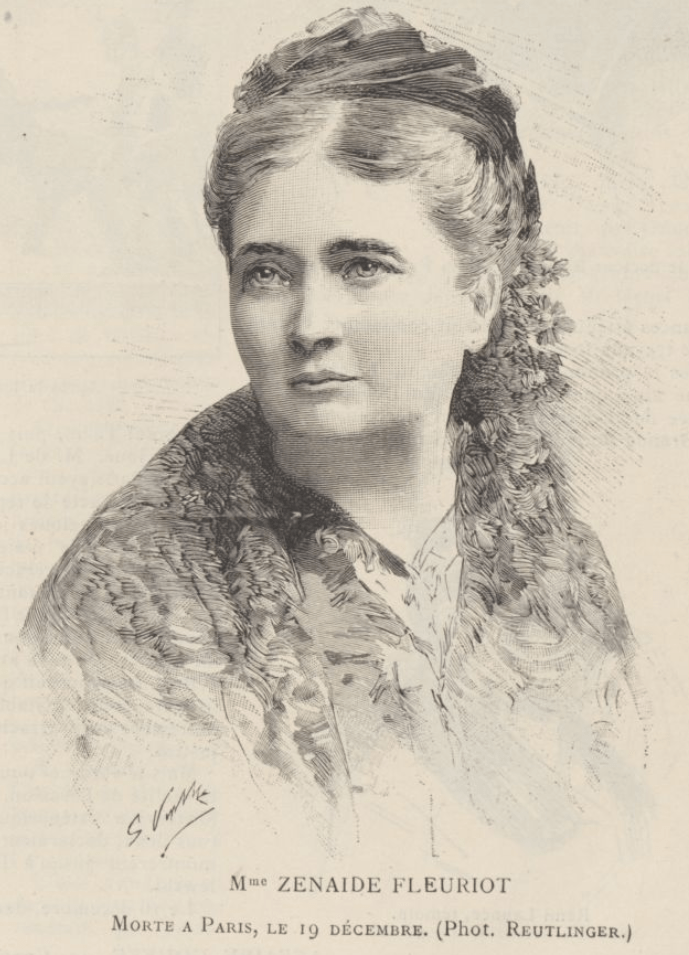
But the exhortatory nature of Sans Beauté does incorporate a fairly strong element of the very wish-fulfillment that I mentioned in my conversation with the illustrator. So it would appear, at least on the basis of the book, that Mlle Fleuriot knew very well whereof she wrote.
A few older women, who had known my mother, would speak to me now and then, in a roundabout way, of the unpleasant position I found myself in, and expressed a strong wish that I might marry young.
Marry! It was a means of finding myself at home in a house of my own, and I thought of it often. It was quite natural that I should, and I turned the thought over in two different ways: I was not pretty, and my mother’s fortune, considerable though it was, was not enough to procure me what is called a fine match. And so, I might marry either a poor young man, or a man of a certain age who would set the qualities of character and heart above the charms of the face.
That was the reasoning that dictated my choice, and my husband would, I supposed, be neither very handsome nor very brilliant, I had made up my mind to that; an honest man, nothing more.
When imagination had a hand in it, the argument changed; I was no longer ugly, and I met, on my road, one of those privileged beings that the imaginations of eighteen create, at their more roving hours — the ideal of husbands, in short. This lasted but a little while, I was, in fact, a fairly practical sort of person, and had not, thank heaven, my head stuffed full of romantic fancies. It was the only excursion I allowed myself into the country of fancy, and it came upon me only when, weary, disgusted with reality, I felt the need to dream of an existence pleasanter than the one I led.
If we have learned anything about the relentless deceit of the modern world, it should should not be surprising that a novel written in 1884 by a never-married religious woman would provide a much more accurate guide to understanding female behavior and psychology than modern psychologists and scientists with the advantage of nearly 150 years of additional data.
Some things never change. Only the circumstances in which we find them do.
Vox, I think your conversation with Clockworkpaperdoll reveals an interesting convention. Manga has spent decades proving that ordinary-looking male protagonists can carry a story because readers grow attached to who they are, not just how they look. I think that’s an angle we haven’t tried more with female protagonists. 🤔
A plain heroine isn’t visually uninteresting. She simply has room to become beautiful through the story instead of arriving that way on page one. Readers don’t just enjoy looking at pretty faces; they also enjoy watching compelling characters come alive. 🤔
Perhaps the question isn’t whether plain women deserve to be protagonists. It’s whether visual storytellers all over have mistaken a convention for a necessity. 🤔
Most of the popular books starring female characters that I can recall have plain or funny looking protagonists. Jane Eyre, Anne Shirley, Sara Crewe, many of Jane Austen's female leads, the narrator in Rebecca... Even Scarlett O'Hara is described as "not beautiful" even though she's charming, and the heroic Melanie is very plain. In the books I've read, the beautiful female lead is the exception (I can't even think of any.)
They're plain in the books, but then when they're portrayed visually, they're almost always far more attractive. We're totally ok with reading about plain women but much less ok with drawing them or casting them in film.