

SSH is Not Evolutionary Psychology
Why you never see evopsych references here
In most Game-related or dating-related sites, you will often see an amount of evopsych utilized, which is to say explanations of various behaviors are offered on the basis of the way in which human psychology evolved through natural selection over time. But you won’t see it here, first because we don’t concern ourselves with Why things are, second because both psychology and evolutionary biology are irreproducible garbage sciences.
Consider: the ten most oft-cited evolutionary psychological explanations, based on citation accounts in Evolution and Human Behavior and similar journals, are:
1. Parental investment theory (Trivers, 1972). The keystone. The sex required to invest more in offspring evolves to be choosier; the lesser-investing sex evolves to be intrasexually competitive for access to the choosier sex. Used to explain essentially every documented sex difference in mating behavior, from female selectivity to male intrasexual aggression. Probably the single most-cited piece of theoretical apparatus in the field.
2. Sex differences in mate preferences (Buss, 1989). The 37-cultures study, surveying over 10,000 people across 33 countries, claimed males prioritize cues of fertility (youth, physical attractiveness) and females prioritize cues of resources (ambition, status, earning capacity). It is the most-cited empirical paper in the field and the workhorse citation whenever anyone writes about cross-cultural mating universals.
3. Waist-to-hip ratio as a fertility signal (Singh, 1993). Singh proposed that the WHR was a signal of female fertility and thus a measure of attractiveness, with the canonical preferred ratio being roughly 0.7. Cited everywhere as a putative cross-cultural invariant, though, as we’ll come to, the theoretical basis is shakier than the citation count suggests.
4. Kin selection / inclusive fitness (Hamilton, 1964). Altruism toward relatives is explained by the fact that helping relatives propagates copies of one’s own genes residing in their bodies. Hamilton’s rule (rB > C) underlies nearly every evopsych account of family dynamics, nepotism, grandparental investment, and adoption preferences.
5. Reciprocal altruism (Trivers, 1971) and cheater detection (Cosmides & Tooby, 1989, 1992). Cooperation among non-kin is sustained by reciprocal exchange, which requires a specialized cognitive module to detect free-riders. Cosmides and Tooby’s work on cheater-detection supported the idea that humans are particularly adept at detecting others who have cheated on social contracts, demonstrated through the famous Wason selection task variants. This is the field’s flagship example of a “content-specific” mental adaptation.
6. Sexual jealousy and the stepparent effect (Daly & Wilson, 1988). The “Cinderella effect”: children living with a stepparent face dramatically elevated risk of abuse and homicide compared to children living with two biological parents. The presence of a stepparent in a household is, they argue, one of the primary predictors of fatal violence toward children. Explained as a byproduct of evolved parental investment psychology that calibrates effort to genetic relatedness.
7. Sex differences in jealousy (Buss et al., 1992). Men are predicted to react more strongly to sexual infidelity (paternity uncertainty); women to emotional infidelity (resource diversion). One of the most-replicated and most-disputed findings in the field, with an entire cottage industry of methodological critiques and counter-replications.
8. Costly signaling / fitness indicators (Zahavi 1975; Miller, 2000). Conspicuous, expensive traits — peacock tails, but also human art, music, humor, charity, and conspicuous consumption — evolved because their cost guarantees their honesty as signals of underlying genetic quality. Miller’s The Mating Mind extended this to claim that facets of human art likely evolved as fitness indicators and serve evolutionary functions associated with mate-acquisition. This is the standard evopsych account of why humans bother with poetry, sports cars, and philanthropy.
9. Evolved fears and “prepared learning” (Seligman; Öhman & Mineka). Humans acquire phobias of snakes, spiders, heights, and darkness far more readily than phobias of cars, electrical outlets, and guns — despite the latter being statistically more dangerous in the modern environment. Explained as an ancestral environment of evolutionary adaptedness (EEA) carryover: the cognitive system was tuned to threats that mattered on the savanna, not threats that emerged in the last two centuries.
10. Male coalitional violence and the “warrior” hypothesis (Wrangham; Tooby & Cosmides; Daly & Wilson). Male-on-male homicide rates dwarf female rates in every society ever studied. Explained as the output of an evolved psychology for intrasexual competition over reproductive access, since ancestral males with no mating prospects had little to lose by escalating, while females faced asymmetric costs from violence. The young-male syndrome — risk-taking peaking in late adolescence and dropping with marriage and fatherhood — is the canonical empirical pattern.
These explanations are nonsensical and false for three reasons:
Psychology is a garbage science.
Evolution by natural selection is impossible
Neutral theory is garbage and misapplied math
As it happens, I’m a literal expert on the subject, having written three books on it collectively known as The Mathematics of Evolution. In Hardcoded, I developed the decay function of professional science based on known percentage of irreproducible professionally-published, peer-reviewed papers combined with the structural incentive toward the embrace of low-quality new developments and the known correction rate.
Social Psychology
Starting unreliability (1975): ~20%
Citation amplification (α): ~16-20 (high; “surprising” findings dominate)
Correction rate (C): ~0.01 (virtually nonexistent)
Years in decay: ~50
Current estimated garbage rate: 85-90%
The Open Science Collaboration’s 36% replication rate published in 2015 for 2008 papers suggests the field was already at 64% unreliable seventeen years ago. This attempt to replicate 100 psychology studies got effects in roughly 36 percent of cases, and the effect sizes that did replicate were on average half the originally reported magnitude. The decay has continued. Social priming, ego depletion, power posing, stereotype threat, growth mindset—the field’s greatest hits have fallen one by one. What remains is a literature where the safest assumption about any individual finding is that it is false.
Projected 100% collapse: Already effectively complete. The field produces occasional valid findings, but they are indistinguishable from the noise without independent replication. The professional literature is not a reliable guide to human social behavior.
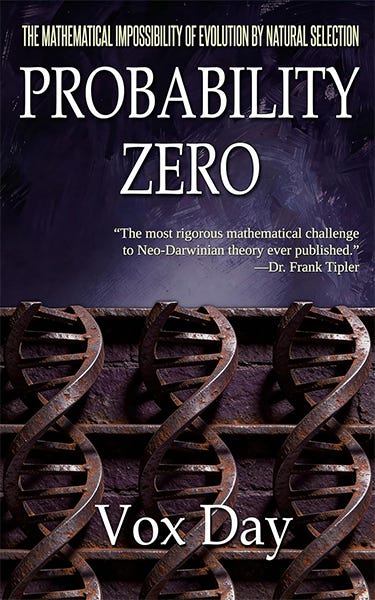
As for evolution itself, I just released the second edition of Probability Zero yesterday in ebook; the print editions will follow next week. The second edition was required by a new paper in Nature that significantly increased the observable genetic gap from the oft-cited 1.2 percent difference comprised of 40 million base pairs that distinguish Pan troglodytes from Homo sapiens.
In fact, the complete genetic difference between chimps and humans has turned out to be 13.8 percent, with 410 million base pairs separating the two lineages since the Chimpanzee-Human Last Common Ancestor. This 10x increase in the number of observed differences between the two genomes has had, as you might expect, a tremendous impact on the arguments I presented in the first edition of this book. In fact, it made them approximately ten times more conclusive.
And while I won’t bore you with an explanation of the algebraic flaws of neutral theory, which as traditionally calculated can only be applied to bacteria, the appendices of Probability Zero and the papers in The Frozen Gene both address it, particularly these two:
The End of Evolutionary Deep Time: Five Independent Constraints on the Molecular Clock and the Recalibration of the Human-Chimpanzee Divergence
Kimura’s Fixation Calculator: Providing Neutral Theory With Predictive Capacity
ABSTRACT
The molecular clock rests on a single theoretical result: Kimura’s (1968) demonstration that the neutral substitution rate equals the mutation rate, independent of population size. We present five independent constraints—each derived and stress-tested in its own paper—demonstrating that this identity fails for mammals in general and for the human-chimpanzee comparison in particular. The five constraints are mathematically independent: each attacks a different term, assumption, or structural feature of the molecular clock. Their convergence is not additive—they compound. The standard model of human-chimpanzee divergence via natural selection was already mathematically impossible at the consensus clock date by six orders of magnitude. At the recalibrated date of the Chimp-Human Last Common Ancestor, the impossibility of the Neo-Darwinian Modern Synthesis as a viable explanation becomes even more obvious.

This is a good place for a trusting person to start. I meticulously trusted government diet advice, and am diabetic. It’s garbage science.
Ok I didn’t take the vax, but for years I carefully injected myself with 6-11 servings of bread and cereal and 3 glasses of milk daily. I also carefully took protein powder. I believe my body quit well before this year.
Still my doctor won’t even call me diabetic because I pass all the A1c’s and fasting tests because now I actually know what to eat and do that just as religiously. After being one of these annoying entitled patients I finally got approved for an cgm after a 38 reading. Now I have data to show them my sugars in the low 40s and 50s, and over 200s for hours, including 380.
It kills me how much I parroted this stuff to people, at least I can give all the people who didn’t believe me when I said I didn’t feel good after eating something sugary was just silly a break. We are pretty brainwashed. I hate garbage science.
Some game coaches those are. Imagine if you went to basketball practice and the coach started explaining the history of the sport and why the rules are what they are.