

Monster Control Inc. 36
Under the Ice
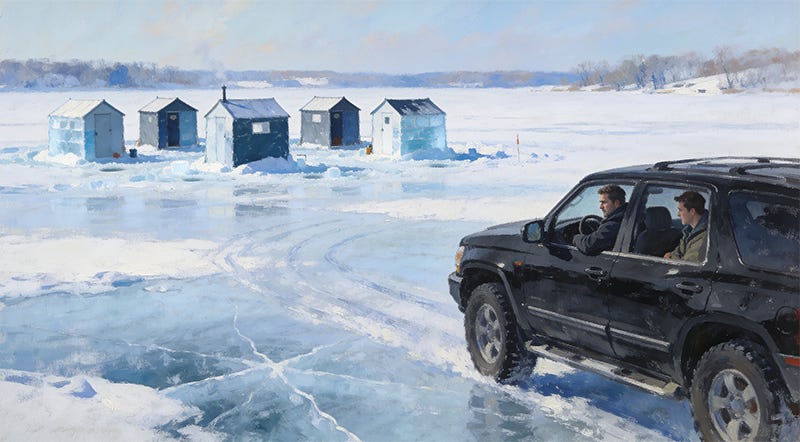
The drive out to Lake Minnetonka took forty minutes through snow that hadn’t decided yet whether it wanted to be a blizzard or just an extended act of atmospheric passive aggression. The sky was the color of old pewter, and the temperature gauge on the MCI pool truck read negative fourteen before windchill.
Reb Jackson was in the passenger seat doing something complicated with a thermos of coffee that involved at least three separate accessories. Grant-Smyth was in the back with his casebook open on his knee, reading in the dim light like a man who considered discomfort a character-building exercise.
Carlson had handed us the file that morning. Five fishermen. Ten days. All of them gone from the deepest sections of the lake, the spots out past the second channel marker where the bottom dropped away to something the locals called the Pit. Ice fishermen went out there for the big walleye and the trophy northerns that liked cold, dark, deep water. None of the five had come back.
The Hennepin County Sheriff’s Department was calling it accidents. Thin ice. Alcohol. One deputy had written in his report that ice fishermen took risks and occasionally those risks caught up with them. That was probably true in a general philosophical sense and completely wrong in this specific situation.
Carlson had flagged it because the disappearances clustered too tightly. Same area. Same ten-day window. Same nothing left behind.
“Tell me about the lake,” Reb said, getting the thermos sorted.
“Big. Cold. Famous for a song about it, I’m told. Lots of recreational fishing, some waterfront money on the northern shore.” I kept my eyes on the road. “The Pit is out past the public access on the southwest corner. That’s where all five of them were fishing.”
“Deepest point?”
“Hundred and thirteen feet.”
Grant-Smyth looked up from his casebook. “Ice depth?”
“That’s the thing.” I took the county road turnoff. “DNR measured it two days ago. Thirty-one inches in the deep sections. That’s a record going back to when they started keeping records.”
Grant-Smyth made a note.
The public access was deserted when we pulled in, which wasn’t surprising given that five men had walked onto this lake and not walked off it. There was a handwritten sign zip-tied to the gate: AREA CLOSED - SHERIFF’S DEPT. We had credentials that covered that kind of thing.
The cold hit me like a door slammed in my face. I had good gear — MCI issued cold-weather kit that was better than anything you could buy retail — but thirty-one below zero with wind made even good gear feel optimistic. Reb, who had hunted things through the Everglades, was moving with the careful deliberateness of a man operating outside his comfort zone. Grant-Smyth looked like he was personally offended by the temperature.
We walked out onto the ice in a spread of about twenty feet, all of us watching our footing. The surface out here wasn’t smooth — it was ridged and fractured and re-frozen in patterns that suggested the ice had gone through some stress. Which was strange for a winter that had been consistently cold.
The first fishing hole was three hundred yards out. Or what had been a fishing hole.
“Well,” Reb said, and stopped.
I stopped next to him. The hole was wrong. Fishing holes are eight inches, ten inches, maybe twelve if the guy is using big equipment. You drill them with an auger, they’re round and clean and they freeze back over if you leave them.
This hole was four feet across and ragged at the edges. Not drilled. Opened. From below.
Grant-Smyth crouched down and examined the ice around the rim. He had good gloves — thin enough to preserve dexterity — and he ran two fingers along the edge with professional care.
“Scoring,” he said. “Regular pattern. Something with considerable reach.” He stood up. “This wasn’t equipment failure and it wasn’t a man falling through. Something came up.”
“Something big,” Reb said.
We found four more holes over the next hour, all of them in the deep section, all of them showing the same ragged, forced-open quality. The marks around the edges weren’t identical but they shared a family resemblance — parallel scoring, widely spaced, suggesting something with significant grip strength working from underneath.
I found the drag marks on the fifth hole.
They were partially obscured by a night’s worth of blowing snow, but they were there — long furrows in the ice surface leading back to the water, interrupted by dark staining that the cold had preserved better than it should have. A lot of dark staining. I crouched down and checked it without touching anything.
The amount of blood was disturbing on a level that went past professional and into something more fundamental. Whatever had come up through that ice hadn’t been in a hurry. It had taken its time.
“We need to talk to the local tribal community,” I said.
“Which is what, exactly?” Grant-Smyth asked.
“I know a guy.”