

It's Not Just Japan
The world doesn't owe you interest or understanding
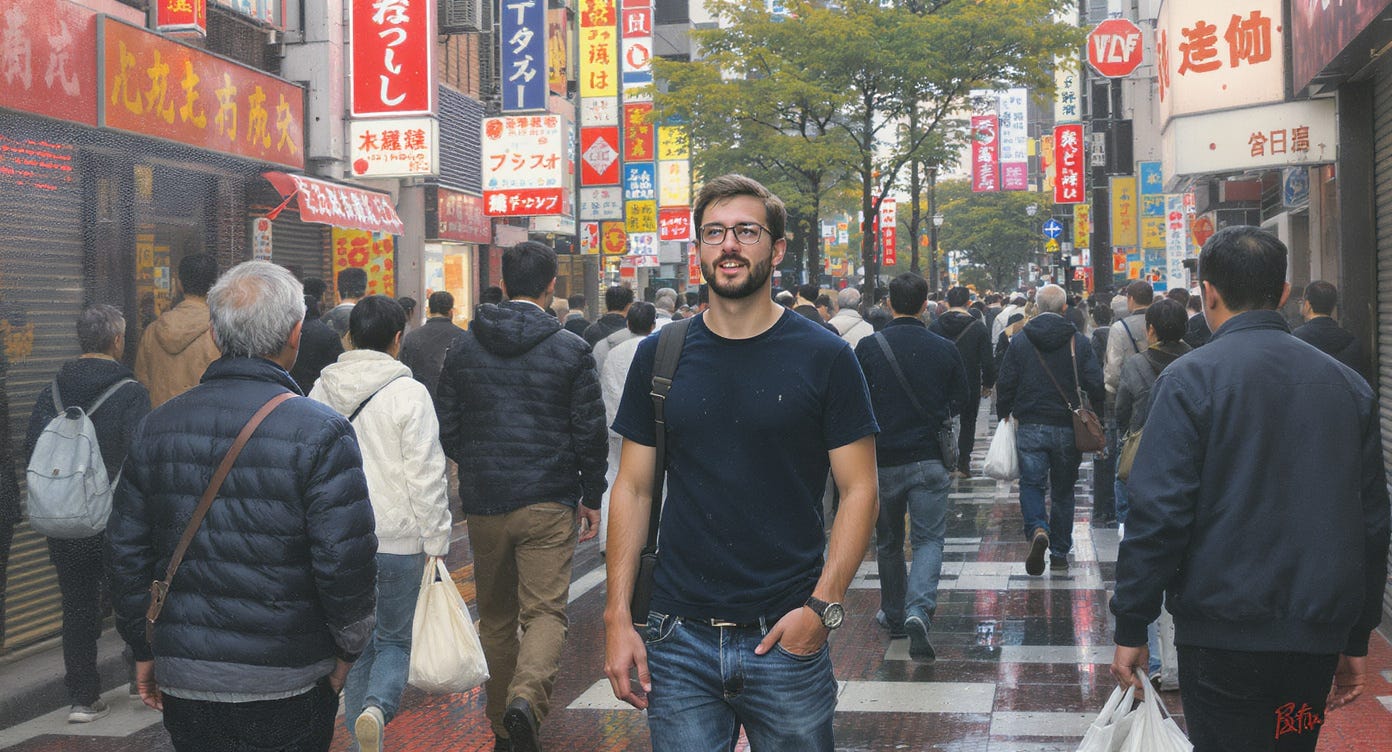
An article in Japan Today has important ramifications that go considerably beyond the borders of Japan:
You’ve heard it before: “Japanese people are hard to get close to.” Maybe you’ve even said it yourself, after a long, lonely weekend or over drinks with coworkers when nothing seems to click. It’s a comforting little excuse, isn’t it? Puts all the blame on some unidentified other. The best part is that you get to be the misunderstood outsider, the lone wolf valiantly fighting against a closed society, maybe even against the system itself.
But pull up a chair. We need to talk. Because lately, I’ve been hearing you complain (loudly, in English, usually within earshot of Japanese people) that “Japanese people are cold” or “Japan is racist.”
But is it really them? Maybe it’s you? It’s you, isn’t it?
I know that’s tough to hear, but let me just make a few points before you tell me (loudly) what you think.
Japanese People Don’t Owe You Attention
Here’s the truth you don’t want to hear: Most Japanese people aren’t cold, unfriendly or actively plotting against you. They just don’t owe you attention.
Yes, Japan has cultural barriers: language, group dynamics, the whole kuki yomenai (take a hint) thing. But labeling every awkward encounter as “prejudice” is lazy and guilty of the very prejudice that you’re talking about.
Now, don’t get me wrong, prejudice and downright racism exist, of course, but not every blank look or polite excuse to leave is a personal attack. Sometimes people just — now bear with me here — just don’t want to talk to you. Those people laughing about something are probably not laughing at you; they probably aren’t even aware you are there.
Let’s flip this around. Back home, when that random exchange student who barely spoke your language wanted to hang out, did you drop everything and instantly become best friends?
I’m not psychic, but I’m willing to bet that you smiled, nodded, maybe tolerated them at parties, and then went back to your circle. So why are you shocked that Japan isn’t rolling out a red carpet for you, the foreigner who can barely string together a sentence in Japanese?
You’re not the center of the universe. And, brace yourself, you’re probably not that interesting either.
Young people who go abroad tend to disproportionately have the same “Main Character Syndrome” that so many Gammas exhibit in their native lands. Perhaps this is because its natural to not quite consider foreigners entirely human, or entirely real, because it can be incredibly bizarre how foreign exchange students, tourists, and immigrants appear to imagine the natives they are visiting have been secretly harboring a hunger for knowledge of their home country and would welcome nothing more than a monologue informing them about it.
It can be comical at times. Sarah Hoyt, the science fiction writer who has lived in the United States for most of her adult life, still regularly writes long essays about what life in Portugal used to be like 40 years ago for the education and edification of her American readers despite their near-complete lack of interest in the topic. Out of a combination of sadism and morbid curiosity, I checked her site, wondering when her most recent reference to growing up in Portugal would be… and voila, the most recent reference was yesterday.
Well, excuse me, I lived in a village growing up. And while I miss some things, sometimes, if you think for a little very Odd kid it was an ideal environment, you’re out of your ever loving mind. In fact, it wasn’t an ideal environment for anyone, judging by the epic fights and factions. Because people in point of fact had very little in common, and were together by utter necessity, which means that the group enforced absolute conformity and you couldn’t escape.
Keep in mind that the woman is referring to her childhood experience in an impoverished rural village in a European backwater in order to dismiss the sense of a lost world quite rightly felt by Gen X suburbanites. After four decades in the USA, she still doesn’t know anything about America.
There are few people anywhere in the world who have hosted a foreign guest in their homes without being subjected to an impromptu lecture on how things are done in Germany/Israel/Australia/America/Portugal without requesting the information.
I’m not saying one should never answer questions about one’s homeland from curious natives; obviously being a good guest requires discussing the topics of interest to the hosts. But there is a tremendous difference between satisfying someone’s genuine curiosity and assuming someone’s interest ex nihilo.
In like manner, Gammas and other individuals of a highly self-centered persuasion should never forget that no one asked. So stop “helping”. Stop “informing”. Stop “in case anyone wanted to know”. Stop “explaining”.
Never answer questions that nobody asked.
It doesn't even even require going to a foreign country. I live in a tiny rural area that has gone from merely being a tourist trap to a "let's move to the bucolic countryside" since the Covids. The big city newcomers believe we yokels are just waiting breathlessly for them to tell us How It's Done (tm) and are flabbergasted by the complete lack of interest.
Meanwhile, they do stupid stuff like wandering into cornfield to take selfies for Instagram. The obliviousness is astonishing.
The flip side of Main Character Syndrome is the psychic crash on the other side. I've been in Japan 25 years. Every few weeks I'll invariably see some sad weeb, Great White Otaku, misfitted goofus sitting somewhere historic or scenic - a small shrine, a local site, a traditional shop - with this 1000 yard stare, almost in tears. I've seen this hundreds of times. It's the failure of their entire life fantasy. The final world's end collapse of their ego fiction. No zany schoolgirls ever come to whisk them to a magical land. They aren't pulled aside by an old wizard and told they have special skills. They don't inadvertently rescue a demon princess. It's just....people on subways, bored of life (and increasingly hostile to foreigners of all stripes), that don't speak in subtitles. I don't know what happens after that. The longest I watched a guy was 4 hours; I was curious. He just sat there. I've seen this 'look' hundreds of times now. At it's core it's sad because it indicates a mind so detached from reality and society that they're almost irredeemable.