

Drucker and the SSH
An analysis of whether the SSH merits updating management theory
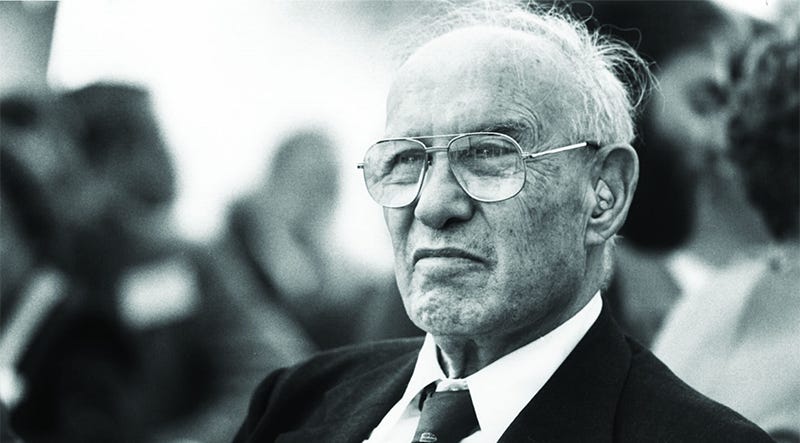
Peter Drucker’s most enduring insight, the one that runs through everything from The Practice of Management through The Effective Executive to Management Challenges for the 21st Century, is that people are not interchangeable units. His entire body of work is a sustained attack on the Taylorist assumption that workers are exchangeable inputs to be optimized through process engineering. He insists, over and over, that the central task of management is putting the right people in the right positions and then getting out of their way.
That is, almost word for word, the thesis of the corpocracy chapter of Sigma Game. The SSH as a corporate tool opens by identifying the same problem: “Every corporation on the planet faces the same fundamental problem: it puts the wrong people in the wrong roles.” Drucker spent forty years saying exactly that, but the SSH provides something Drucker never had, which is a systematic vocabulary for why it keeps happening and a classification framework for which people belong in which roles.
Drucker’s strengths-based management philosophy is similarly compatible. His famous dictum that you should “make strengths productive” rather than trying to fix weaknesses maps almost perfectly onto the SSH principle that Deltas should not be forced into management, Sigmas should not be forced into teams, and Gammas should not be placed where their organizational destructiveness can corrode morale. Drucker knew that a brilliant engineer promoted into management would fail; he just didn’t have a name for why beyond vague references to temperament and aptitude.
The Peter Principle connection is also explicit. The corpocracy chapter cites it directly while Drucker addressed the same phenomenon from a different angle. The SSH doesn’t just observe that men are promoted beyond competence, it explains the specific mechanisms for how and why it happens. The Delta gets promoted because his individual contributor excellence is misread as leadership potential. The Gamma gets promoted because his aggressive self-advocacy is mistaken for Alpha confidence. Drucker described the symptoms; the SSH identifies the pathology.
The fundamental divergence:
Drucker’s framework is, at bottom, voluntarist. He believes that effectiveness is a habit that can be learned, that leadership can be developed through practice and discipline, and that any reasonably intelligent person can become an effective executive if he follows the right principles. The Effective Executive is literally structured as a self-help book for managers: here are the five habits, now go practice them.
The SSH rejects this completely. The hierarchy is observational and descriptive. Deltas don’t become Alphas through self-improvement courses. Gammas don’t graduate into Bravos by reading the right management book. The SSH is built on the premise that these behavioral patterns are stable, recognizable, and largely resistant to training interventions. You can help a Gamma graduate from his worst habits, but you can’t turn him into a Bravo. You can develop a Delta’s skills within his natural range, but you can’t give him the social dominance of an Alpha.
This is a fundamental philosophical disagreement, not a minor quibble. Drucker’s entire consulting practice was built on the assumption that organizations could be taught to manage well. The SSH instead suggests that organizations need to classify well, which is a completely different proposition. One concept produces training programs; the other indicates a need for AI-driven behavioral analytics.
Drucker is also notably egalitarian in his treatment of workers. He genuinely believed in the dignity and potential of every employee, and his later work on knowledge workers and self-managing communities is built on the assumption that most people, given the right conditions, will rise to the occasion. The SSH is far more realistic about the general distribution of capabilities. It acknowledges that Deltas are the backbone of every organization without pretending that their strengths are equivalent to Alpha strategic vision or Sigma innovation. Drucker would have been uncomfortable with the explicit ranking system, even though he implicitly acknowledged the same reality in his own work.
