

Alphas in the Wild
How chimpanzees inform human hierarchy
A 2009 study entitled “Male dominance rank and reproductive success in chimpanzees” casts some useful light on the extent to which Alphas can be expected to monopolize female attention in a human hierarchy:
At the time of conception, there were, on average, 10.5 candidate males (range 7–12) and 3.9 simultaneously oestrous females (range 1–11) (Table 1). We found that paternity success decreased according to rank as predicted by the priority of access model, reaching significance in a one-tailed test and a trend towards significance in a two-tailed test (Spearman rank correlation: rS = 0.54, N = 12 rank positions, one-tailed P = 0.034, two-tailed P = 0.068; Fig. 3). The alpha male (rank 1) secured the most offspring, siring 30.3% of the offspring, which was somewhat less than the 36.8% predicted but still 50% more offspring than the next most successful males (ranks 2 and 5). While the highest-ranking males (ranks 1–4) were less successful than predicted, males of lower ranks (5 and below) did as well as or better than predicted, and in some cases, as well as or better than males of higher rank.
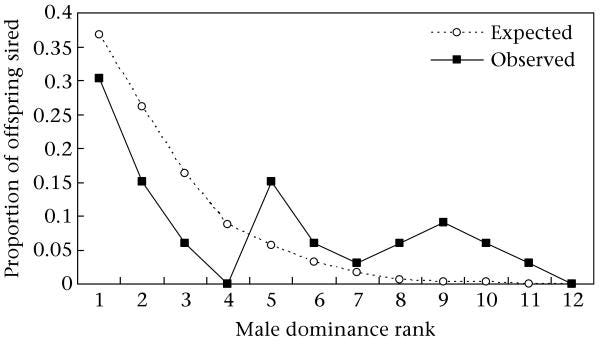
This is actually better than the Pareto principle, or 20/80 rule would tend to suggest. And it’s more reflective of the size of an actual hierarchy with a single Alpha. It also suggests that if Alphas are currently involved with more than 25 percent of the local women, that it is the availability of birth control rather than a natural pattern that is responsible.

Now, humans are not chimpanzees, obviously, but studies such as these do provide us with at least a starting point for how to analyze the patterns of human group behavior that are not as easily observed to this level of detail. It also may help explain the persistence of Gammas and their ability to perpetuate themselves despite their relative unattractiveness to women.
While our work confirms that male rank typically predicts male chimpanzee reproductive success, other factors are also important; mate choice and alternative male strategies can give low-ranking males access to females more often than would be predicted by the model.
I suspect that the women here can explain what those “alternative male strategies” would be in human terms. Regardless, the fact that evolution is junk non-science and it is mathematically impossible for humans to have “evolved” from a common primate ancestor does not mean that information about other species has no relevance to human behavioral patterns.
I recall a documentary years ago that helps explain the success of the non Alphas.
They stick to their targted female like glue, and when she is ready to mate, he is there on the spot, while the Alpha is off doing Alpha things.
Opportunism is a success strategy for many animals it seems.
Someone needs to get Neil Gaiman on here to explain what those "alternative male strategies" would be, he is seemingly quite familiar with them.