

Alpha vs Sigma
An example of SSH from Japanese history
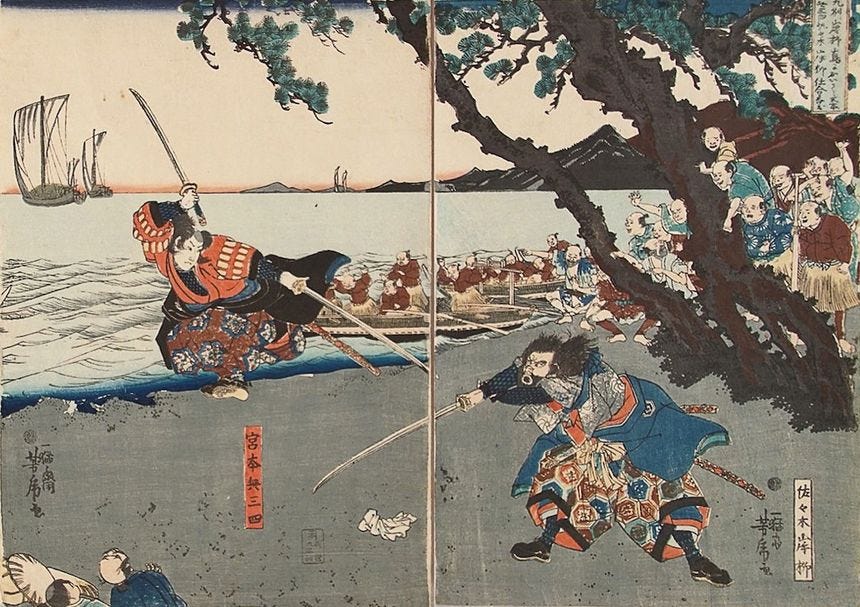
The immediate and instinctive conflict of wills that precedes any physical confrontation is well-known by every trained fighter. This example from MUSASHI, by Eji Yoshikawa, a novel that was published in serialized form in the Asahi Shimbun from 1935 to 1939, is a classic description of the challenge before the conflict.
“That has to be him,” thought Sasaki Kojiro, the man leaning against the willow. He had heard of Musashi many times, but this was the first time he had set eyes on him.
Musashi was wondering: “Who could he be?”
From the instant their eyes met, they had silently been searching, each sounding the depths of the others spirit. In practicing the Art of War, it is said that one must discern from the point of the enemy’s sword the extent of his ability. This is exactly what the two men were doing. They were like wrestlers, sizing each other up before coming to grips. And each had reasons to regard the other with suspicion.
“I don’t like it,” thought Kojiro, seething with displeasure. He had taken care of Akemi since rescuing her from the deserted Amida Hall and this patently intimate conversation between her and Musashi upset him. “Maybe he’s the kind who preys upon innocent women. And her! She didn’t say where she was going and now she’s up there weeping on a man’s shoulder!” He himself was here because he’d followed her.
The enmity in Kojiro’s eyes was not lost on Musashi, and he was also conscious of that peculiar instant conflict of wills that arises when one shugyosha encounters another. Nor was there any doubt that Kojiro felt the spirit of defiance conveyed in Musashi’s expression.
“Who could he be?” thought Musashi again. “He looks like quite a fighter. But why the malicious look in his eye? Better watch him closely.”
The intensity of the two men came not from their eyes but from deep inside. Fireworks seemed about to erupt from their pupils… As a vicious dog snarls when it sees another vicious dog, so both Musashi and Kojiro knew instinctively that the other was a dangerous fighter.
I was fairly sure that Miyamoto Musashi was a Sigma on the basis of his portrayal in the novel, but the manner of his early retirement tends to confirm the diagnosis.
In 1633, Musashi began staying with Hosokawa Tadatoshi, daimyō of Kumamoto Castle, who had moved to the Kumamoto fief and Kokura, to train and paint. While he engaged in very few duels during this period, one occurred in 1634 at the arrangement of Lord Ogasawara, in which Musashi defeated a lance specialist named Takada Matabei. Musashi officially became the retainer of the Hosokawa lords of Kumamoto in 1640… In 1643, he retired to a cave, Reigandō, living as a hermit to write THE BOOK OF FIVE RINGS. He finished it in the second month of 1645. On the twelfth of the fifth month, sensing his impending death, he bequeathed his worldly possessions, after giving his manuscript to the younger brother of Terao Magonojo, his closest disciple. Musashi died in Reigandō cave around 13 June 1645.
At some point, Musashi killed Kojiro with a wooden sword he carved from an oar on the boat he took to arrive at the fight.
It was a duel and Kojiro took a hundred men to watch him kill Musashi with his sword, just to have his skull crushed with that oar.
Musashi fled the place on the same boat he arrived, before Kojiro’s men could catch him.
"The immediate and instinctive conflict of wills that precedes any physical confrontation is well-known by every trained fighter."
Man, so true. When I was a teenager there's this that my coach said that really stuck with me. It's very very far from the subtlety of the Art of War, but it's the way I prefer to do it.
"Don't try to surprise anyone. Good fighters have 2 good moves. Champions have maybe 3. He has to know what you're going to do. And he has to know there's nothing he can do about it. That's true mastery."